When I was in the process of creating the OpenGL loader that I
described in my last blog
post, I forgot to add the WINAPI prefix to the function
declarations. Someone pointed out to me on Twitter that the code would
fail on 32-bit compilation. I checked, and it did. Addition of the
WINAPI macro fixed this problem. The WINAPI
macro expands to __stdcall on 32-bit compilation on
Windows.
I had encountered stdcall and more of these mysterious
keywords in the past, but only had a vague idea of what they did. And so
I did some web research, dumped some assembly files, and studied a
three-way diff. What follows is an analysis of cdecl,
stdcall and fastcall, and how assembly code
differs between these three calling conventions.
The experiment
I wrote a small C program:
    int __attribute__((cdecl)) foo(int a, int b) {
        return (a < b) ? a : b;
    }

    int main() {
        int i = foo(88, 99);
        return i;
    }
I compiled the program and generated the assembly using the command
gcc -S -m32 main.c. I did this three times, changing the
value of __attribute__ to cdecl,
stdcall, and fastcall respectively. Then I
diffed the results.
The diff
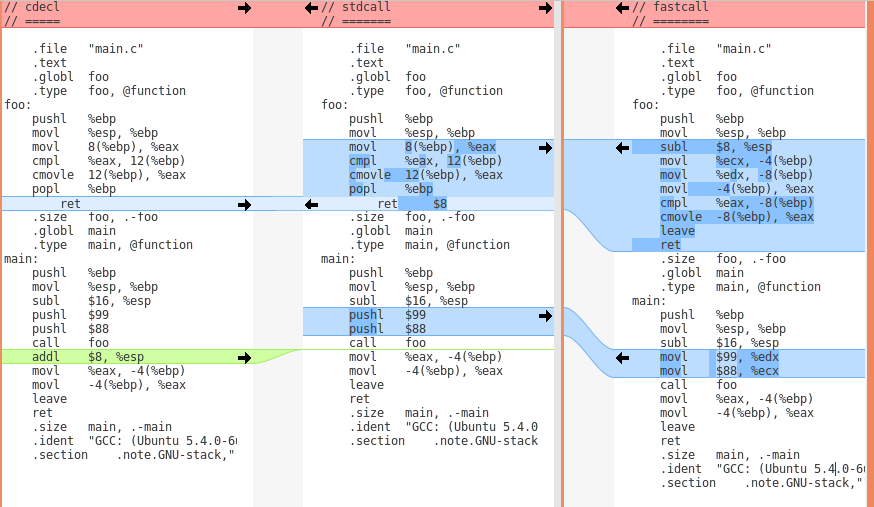
You can find the output text here.
Let’s have a look at the interesting parts of the generated assembly programs:
cdecl
Let’s have a look at the cdecl assembly, starting from
the main: block. In the stack diagrams that follow, memory
addresses decrease as you go down. Thus, in the diagrams below, stacks
grow downward.
    main:
        pushl   %ebp
        movl    %esp, %ebp


        ---------------- <-- esp, ebp
The ebp register stores the base pointer, which is the
base of the stack for the given stack frame. This pointer keeps pointing
to the same location for the lifetime of that stack frame. The
esp register stores the stack pointer. This pointer moves
as the stack grows and shrinks. These two lines of code create a new
stack frame. pushl %ebp pushes the previous value of
ebp on the stack, and the movl %esp, %ebp
moves ebp such that both now point at the same
location.
While returning from a function, you’ll do a popl %ebp
or a leave to restore the value of the previous stack
frame.
    subl    $16, %esp

        ---------------- <-- ebp
            16 bytes
        ---------------- <-- esp
A value of 16 is subtracted from esp. Note that this is
the stack growing downward, and conceptually, esp always
denotes the top of the stack.
    pushl   $99
    pushl   $88


    ---------------- <-- ebp
        16 bytes
    -  -  -  -  -  -
           99        } 4 bytes
    -  -  -  -  -  -
           88        } 4 bytes
    ---------------- <-- esp
The two parameters - 88 and 99 - are pushed onto the stack. This is
because the cdecl calling convention doesn’t allow the use
of registers for passing parameters. 4 bytes are allocated per parameter
because they are ints. The amount of stack space allocated doesn’t
necessarily equate to the sizes of the parameters. Extra space may be
added for alignment purposes.
    call foo
    (body of foo)
    addl    $8, %esp


    ---------------- <-- ebp
       16 bytes
    ---------------- <-- esp
           99
    -  -  -  -  -  -
           88
    -  -  -  -  -  -
Now, the function foo is called. It executes and
returns. Then, we execute an addl instruction to increment
esp, which shrinks the stack. This instruction cleans up
the stack growth that happened when we pushed the two parameters to the
stack. This is because in cdecl, the caller is responsible
for the cleanup.
stdcall
The assembly for the stdcall variant is identical to the
cdecl variant, except that in this variant, the callee is
responsible for stack cleanup. As a result, the addl
instruction in the main function used for cleanup is absent, and the
ret instruction in the foo function is now
ret $8.
fastcall
    movl    $99, %edx
    movl    $88, %ecx
The code here is substantially different, since fastcall
allows us to pass parameters through the ecx and
edx registers. The parameters are now stored in registers
instead of pushing them on the stack. Note that fastcall
only allows us to use these two registers. If more parameters need to be
passed, they spill over into the stack.
    subl    $8, %esp
    movl    %ecx, -4(%ebp)
    movl    %edx, -8(%ebp)
    movl    -4(%ebp), %eax
    cmpl    %eax, -8(%ebp)
    cmovle  -8(%ebp), %eax
Although this code shows up as a substantial diff as compared to the
previous variants, it is (unsurprisingly) functionally similar. It
manually allocates stack space by decrementing esp. Then it
moves the ecx and edx values on to the stack,
based on addresses relative to ebp. Then it proceeds with
the same logic the other variants.
Addresses are different here because the parameters now belong to a different stack frame, than in the previous variants.
Closing notes
To summarize, calling conventions dictate how parameters are passed to functions, and who is in charge of the cleanup. These are the results we found:
| Convention | Cleanup responsibility | Parameter-passing |
|---|---|---|
cdecl |
caller | stack |
stdcall |
callee | stack |
fastcall |
callee | %ecx, %edx,
stack |
Fortunately, in 64-bit compilation, there aren’t as many variants of calling conventions, and things seem to be a bit more sane. As a result, the specifics of the calling conventions investigated above may not be extremely valuable in a modern execution environment. However, this does give us an insight into the mechanics of parameter-passing and stack allocation and cleanup, which should be relevant even today.
If you would like to study this in more detail, Agner Fog has written a really good document on the topic.